
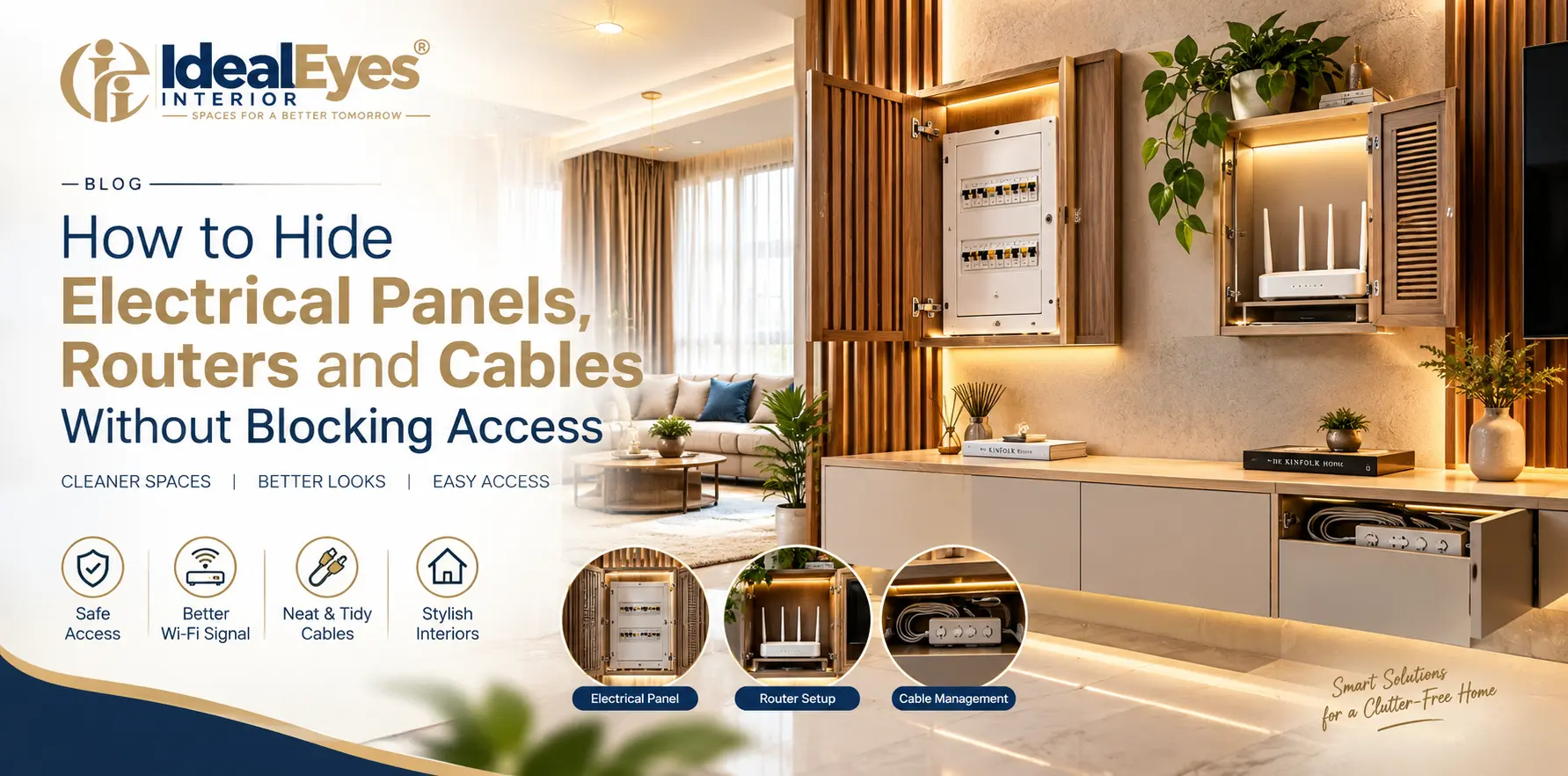
The short answer: disguise the electrical panel, don’t seal it. Use a hinged or sliding cover that opens in seconds, leaves ventilation gaps, and keeps the floor in front clear. Place routers where signal and airflow stay intact. Plan cables before the walls and ceilings are closed.
Most homeowners want the same thing. The grey distribution board by the front door, the blinking router on the TV unit, and the cable tangle behind the sofa should stop dominating the room. The mistake is solving that by boxing everything in. We have seen that choice cause trouble during a power trip, a signal drop, or an electrician’s visit.
This guide covers each of the three problems, plus the Kolkata-specific conditions that affect your choices.
Start With One Rule: Hidden Is Fine, Blocked Is Not
Good concealment looks effortless but stays practical. Anything that hides a panel, router, or junction needs to open quickly. It also needs to breathe, and it must never trap heat.
Why Access Matters More Than Looks
A tripped breaker is routine. A tripped breaker behind a bolted cabinet panel is a problem. Electricians also need clear access for fault tracing, upgrades, and inspections. Behind a sealed cover, a ten-minute job becomes a demolition job.
The 30-Second Test
Before approving any cover design, run this test with your family:
- Can an adult open the cover with one hand?
- Can they reach every breaker without moving furniture?
- Does the cover stay open without being held?
- Can a guest or house helper do it without instructions?
If any answer is no, redesign the cover. Our designers apply this test on site before any finish goes on.
How to Hide an Electrical Panel in a Home Interior
Every approach below follows the same logic. The cover becomes part of the room’s design, and the panel stays fully serviceable behind it.
Hinged Artwork, Mirrors and Shutters
A framed canvas or mirror mounted on concealed hinges is the classic solution. It works well in entry foyers and passages. Add a magnetic catch so the door sits flush but swings open with a light pull.
Keep the frame lightweight. A heavy glass mirror on weak hinges will sag and eventually become a hazard.
Sliding Panels and Louvered Doors
Sliding panels suit narrow corridors where a swinging door would collide with traffic. Louvered doors add built-in ventilation, which helps with heat from the breakers and with Kolkata’s humidity.
Built-In Cabinets and Wardrobes
Sometimes the panel sits inside a wardrobe wall or a shoe unit. Give it its own dedicated door and a clear interior, with no shelves in front. Never use the panel’s compartment as extra storage. If you are planning storage-heavy walls, our guide to hidden storage ideas for small homes in India shows where panels can sit safely within a storage plan.
Decorative Electrical Panel Cover Ideas
If you want something simpler, consider these options:
- Paint the panel door in the wall color so it recedes.
- Apply matching wallpaper on the door only, not over the edges or gaps.
- Add a slim, ventilated metal or wood-look cover that clips on.
- Continue a panel pattern across the door when you are paneling the wall.
Fluted and slatted finishes are popular right now. Our post on fluted wall panels: where to use them and what to avoid explains how to cut a clean access door into a patterned wall.
Comparing Your Options
| Method | Best for | Access speed | Main watch-out |
| Hinged artwork or mirror | Foyers, passages | Instant | Hinge strength |
| Sliding panel | Narrow corridors | Fast | Track alignment |
| Louvered door | Humid areas | Instant | Dust collection |
| Wardrobe or cabinet door | Bedrooms, utility | Fast | Keep interior clear |
| Paint or wallpaper | Minimal budgets | Instant | Don’t seal edges |
What Never to Use
Skip thick curtains, glued-on boards, and screwed-down panels. Avoid anything flammable placed directly against the board. Also avoid fully airtight covers, since breakers generate heat. Your electrician should confirm the final design before the carpenter starts.
How to Conceal a Wi-Fi Router in the Living Room
A router needs three things to perform: airflow, a central position, and an unobstructed signal path. Most hiding attempts fail on at least one of these.
Choose the Position First
Place the router as centrally as the incoming line allows. Raise it off the floor. A shelf at roughly sofa-back height usually spreads signal better than a lower spot. Decide this before you design the furniture around it.
Use Cabinets That Let Signal Through
Wood, MDF, and fabric-fronted panels pass Wi-Fi signal reasonably well. Metal doors and mirror-backed surfaces block it. Choose a slatted or perforated door, and leave a gap at the back for cables and heat.
Many families in apartments get the fiber box and router installed at the entry point, often beside the panel. We often suggest a shared ventilated niche for both, with separate doors. That keeps cabling short and the front room clean.
Hide the Power Adapters, Too
Routers rarely look bad on their own. The adapter bricks and extension boards do the damage. Mount a small multi-socket inside the cabinet, and fix it to the wall rather than leaving it on the floor.
Cable Management Ideas for Home
Cables are easiest to hide before the finishes arrive. After that, every fix becomes a compromise.
Plan Hidden Wiring Ideas for Modern Homes at the Design Stage
During a full renovation, we mark TV points, charging points, router points, and lighting drivers on the drawings early. We then coordinate them with the electrician before false ceilings and wall paneling go up. Conduits are laid in the walls, and junction points stay reachable.
That sequence is why planned homes look clean. If you are thinking about smarter integration, our article on invisible smart home technology covers the wider design approach.
The TV Wall
The TV wall is the biggest offender. A professional setup includes:
- A recessed power and data box behind the TV.
- Conduit running down to a media cabinet or floor box.
- A ventilated compartment for the set-top box and streaming devices.
Desks and Bedside Spaces
Use under-desk trays, cable grommets, and fabric sleeves. Bedside units can carry built-in charging points so phone chargers never trail across the floor.
Fixes for an Existing Home
If walls are already finished, don’t chase them open. Try these instead:
- Surface raceways painted in the wall color.
- Skirting-mounted cable channels.
- Furniture with rear cable cutouts.
- Cord covers where wires cross a doorway.
Raceways must be sized for the load. Never pack extra cables into a channel until it warms up. Only a licensed electrician should handle mains wiring.
Kolkata Conditions That Change the Plan
Climate and building habits here affect every concealment choice.
Humidity and Monsoon Moisture
Kolkata’s humid air and heavy monsoon can swell wood, corrode metal contacts, and damp-stain walls. Choose moisture-resistant boards and keep covers ventilated. Our guide to monsoon-proof home interiors explains which materials hold up best.
Apartment Rules and Utility Meters
In many New Town and Salt Lake flats, some boards or meters sit in common areas. Check what belongs to you and what belongs to the society or the utility. Never block a meter that the utility needs to read.
Dust and Cleaning
Louvers and slats collect dust quickly. Pick designs that wipe clean, and ask your house helper to dust them weekly.
When to Call a Professional
Calling an electrician is not optional for relocating a panel, extending wiring, or modifying a board’s enclosure. Wiring in India falls under established standards such as IS 732, and your electrician should follow them.
Your interior designer then handles the finish. For new homes, add this to your pre-handover review. Our interior design checklist before moving into a new home includes it.
If you want a coordinated plan, contact our team or look through our services.
Frequently Asked Questions
Can I cover my electrical panel with a cabinet or painting?
Yes, if it opens easily and fully. Use hinged or sliding covers that stay open on their own. Don’t block ventilation or put shelves in front. Anyone in the household should reach every breaker within seconds, without moving furniture or using tools.
Is it safe to hide a Wi-Fi router inside a cabinet?
It is safe if the cabinet is ventilated and non-metal. Routers produce heat, so leave open space around them and a gap at the back. Wooden or slatted doors keep the signal strong. Avoid closed metal boxes, which weaken Wi-Fi and trap heat.
What is the best way to hide cables on a TV wall?
The cleanest method is a recessed power and data box behind the TV, plus conduit routed to a ventilated media cabinet. In a finished wall, use a paint-matched raceway. Never run extension boards inside the wall.
Can I move or relocate my electrical panel for better looks?
Only a licensed electrician should move a panel, and it is rarely worth the cost. Disguising it with a proper cover is usually cheaper and safer. If a renovation already involves rewiring, discuss the location early with your designer and electrician.
What should I avoid when covering an electrical panel?
Avoid glued or screwed-down boards, heavy curtains, flammable materials touching the panel, and airtight enclosures. Don’t store items in front of it, and never lock it without leaving a key where family members can find it. Keep every breaker clearly labeled.
About the Author
Ideal Eyes Interior Team writes for Ideal Eyes Interior, a Kolkata-based interior design firm founded in 2010 by Madhusudan Halder at Fern Road, Gariahat. The firm works across luxury residential, hospitality, corporate, and commercial projects, and offers end-to-end services including flooring, painting, wall paneling, and lighting. Its studio is in New Town, Kolkata.